The House Oversight Committee held a hearing on June 4th with the PRC commissioners giving witness testimony. The recording is available for viewing. The hearing was heavily focused on the severe, ongoing, financial crisis facing the United States Postal Service (USPS), the effectiveness of current operational strategies, and the tension between public expectations and economic viability.
The PRC and Congress generally agreed that the current trajectory of the USPS is not self-correcting. Resolving the crisis will require the American public and Congress to make difficult choices about what they genuinely want out of the postal service, moving past the expectation that it can remain universally accessible everywhere without significant restructuring or congressional intervention.
Acting Chairman Robert Taub argued that the first step toward fixing the USPS is for Congress to explicitly define or redefine what the Universal Service Obligation (USO) actually means in the modern era. All PRC commissioners submitted written testimonies.
The USO is primarily outlined in Title 39 of the United States Code (U.S.C.), but it does leave some areas open for interpretation. Below is an overview.
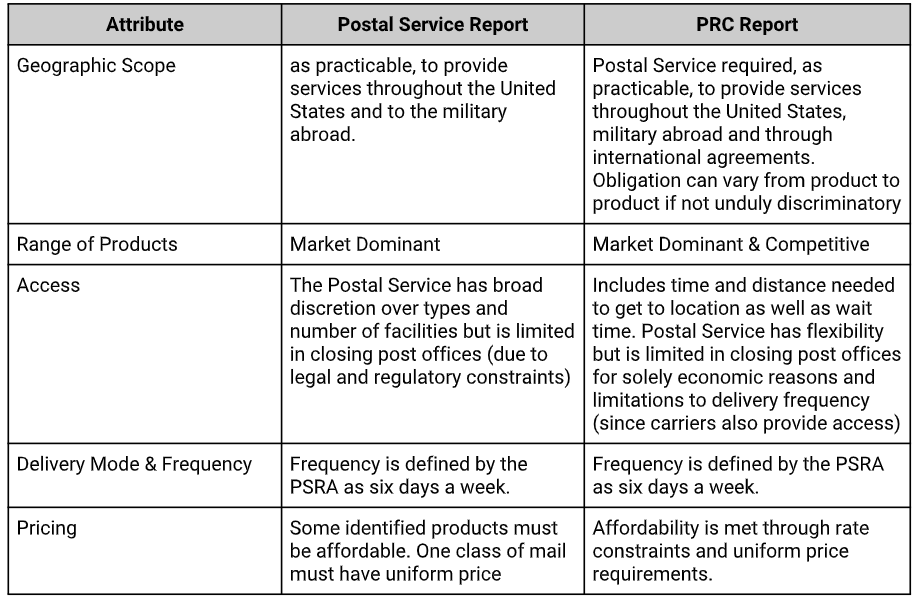
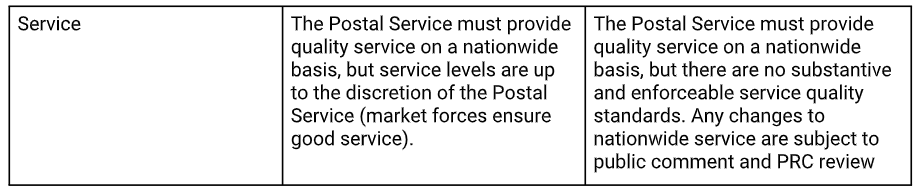
Source: USPS and PRC Reports on Universal Service and Postal Monopolies and the PSRA.
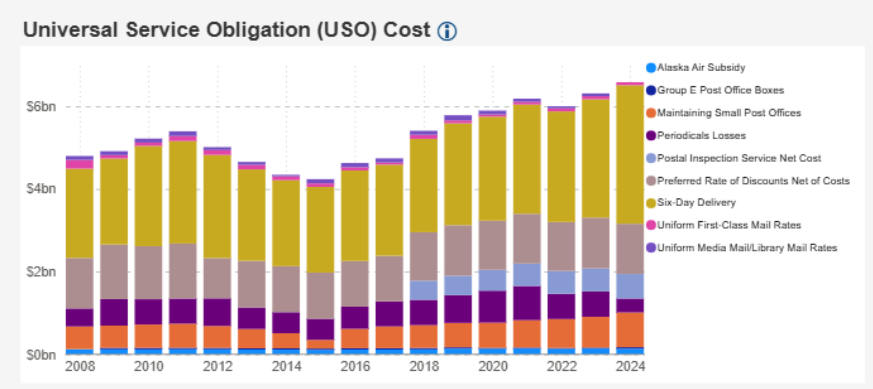
While not all agree on the exact cost of the USO, all agree it is high, and greater than the value of the mailbox monopoly. The FY2024 cost as reported by the PRC was $6.6 billion. The breakdown is six-day mail delivery, free or reduced rates (periodicals, nonprofit rates, free mail for the blind) and geographic and access mandates (operation of small, financially unviable post offices in report areas).
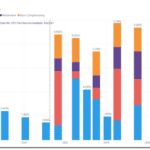
Source of graphs – OIG financial dashboard.
The PRC places the value of the USO at $3.3 billion to $4.0 billion. Because the cost of the USO is greater than its value, it leaves the USPS with a net regulatory burden.