KEY HIGHLIGHTS
- Veterans Day: Mail delivery and postal services will be closed on Wednesday, November 11th for Veterans Day. It serves as a vital reminder to recognize and appreciate the enduring commitment of our service members and their families.
- FY2026 Financials: FY26 ended with a robust Q4, lifting the mail volumes and revenue above plan numbers, but still at a year-end net loss.
- FY2027 Integrated Financial Plan (IFP): USPS presents their 2027 forecasts.
- Midterm elections impact on postal landscape: A look ahead at how governance and oversight of USPS may be impacted by the change in leadership.
- Color Code for Service: USPS continues to use the color code system for incoming mail volumes to help meet service standards.
Section 1: Financial & Regulatory Outlook
USPS Board of Governors Meeting
The USPS Board of Governors (BOG) held two meetings this week, one on Monday November 9th, a morning meeting which was closed under the sunshine act to discuss Strategic Matters, Financial and Operational Matters along with Administrative Matters. Often those meetings include items that the BOG must vote on before USPS can proceed with an action.
On the following day, Tuesday November 10th, they held an open meeting to the public. This meeting is the once annual that allows for a public comment period at the conclusion of the meeting.
The meeting recording can be viewed online with this link.
Below is the agenda that was followed:
-
- FY2026 Annual Financial Report.
- FY2026 Annual Report to Congress.
- FY2027 Integrated Financial Plan and Liquidity Outlook.
- Authorization to Borrow Money and Issue Obligations.
- FY2028 Congressional Reimbursement Request.
- Annual Service Performance Report.
- Approval of the February 2027 Open Meeting Agenda.
The meeting was called to order by Chairwoman Amber McReynolds, she took the opportunity to thank the hard working USPS employees for a successful election season acknowledging that last week over 100 million people participated in the elections, and that USPS holds a critical role in reliable and secure delivery of ballots. She repeated the congressional asks consistent with previous asks and stated that “ultimately our fiscal cliff is here.”
PMG Address
Next the Postmaster General David Steiner delivered an assessment of the Postal Service’s financial state, describing it as a “cash crisis” that requires immediate national attention. PMG Steiner noted that they are on a positive trajectory in virtually all areas where they have control of their business. He said they will focus on what we can control – despite the fuel and headwinds they are meeting their cost revenue goals. They are meeting the revenue goals through “effective pricing, promotions, strong incentives and product development.”
PMG Steiner stated that “Despite our progress on controllable parts of our business there remains larger issues to tangle with in those areas that we do not control.”
The PMG repeated that they require congressional attention and action, and fast.
He went on to say, “they believe there are one of two paths that Congress can choose from,” the first “Congress remove the economical mandates that prevent USPS from being self-sufficient,” or second “fund these uneconomical mandates.” If they removed the mandates (choice one) USPS believes they would control all costs within six months.
If one of these actions does not happen USPS will need to take other steps to improve their financial position, there are a lot of areas like pricing and days of service that they cannot change due to statutory or regulatory restrictions.
So, the PMG says they will have to look at areas that have not been foreclosed to them by Congress or Regulators. “That leaves few options, (1) rationalizing our retail and office footprint to be consistent with our financial obligations, and (2) service standards for non-First-Class Mail.
We will need to make drastic changes in the number of Post Offices, and Marketing Mail service levels.” They will also look at other areas.
They will have a fully developed plan that they will present to leaders in the government in the first quarter of calendar year 2027 so they can make a policy choice of reduced levels of service or funding the mandates.
The PMG closed with acknowledging the recently announced retirement of Peter Pastre, VP of Government Relations & Public Policy, and the earlier retirement of VP of Sales Bill Fraine. Finally, he congratulated Gary Reblin on the appointment to Chief Commercial Officer and thanking the 600+ employees for a stellar year.
BOG Elections
The elections of Chair and Vice Chair were held at the BOG meeting.
Daniel Tangherlini was voted in as the Chair of the BOG. Current Chair is Amber McReynolds.
-
- Commencement Date: Both the Chairman and Vice Chairman are elected for terms that commence on December 1 of the calendar year in which the election occurs.
- Duration: The term runs from December 1 through the election and installation of their successor(s) the following year.
- Exception: The only circumstance under which an election takes effect immediately upon election is if an unscheduled election is held following the death, departure, or resignation of a sitting Chair or Vice Chair prior to the end of their term.
Derek Kan was voted to an additional term as Vice Chair of the BOG.
USPS FY26 Q4 & FY2026 Annual Financial Report
The Postal Service fiscal year ended September 30th, 2026. On November 11th they filed a form 10-K report which provides detailed information about USPS finances, along with their unaudited financials for the month of September.
Financial Overview:
-
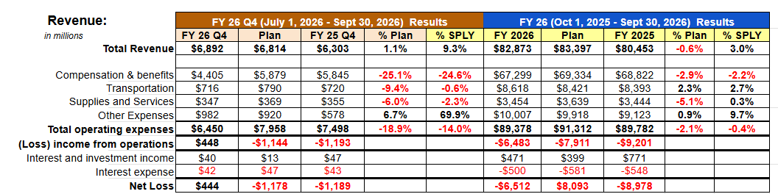
- FY 26 Operating Revenue: Reached $82.9 billion, an increase of $2.4 billion (3.0%) compared to FY 2025.
- Q4 Revenue beat plan by 1.1% and SPLY by 9.3%
- FY 26 Net Loss: Decreased by $2.5 billion to $6.5 billion, compared to a net loss of $9.0 billion in FY 2025.
- Q4 did not experience a loss, they were in the black, beating plan and SPLY.
- FY 26 Controllable Loss: Improved by $344 million to $2.4 billion, compared to $2.7 billion in the prior year.
- FY 26 Operating Expenses: Totaled $89.4 billion, a decrease of $404 million (0.4%) compared to FY 2025.
- FY 26 Operating Revenue: Reached $82.9 billion, an increase of $2.4 billion (3.0%) compared to FY 2025.
Revenue and Volume Performance Summary
-
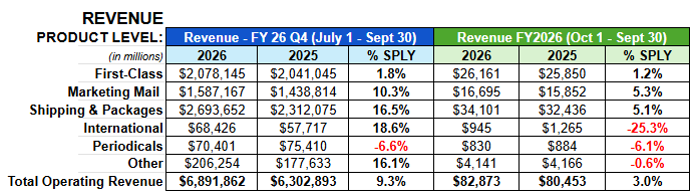
- FY 26 Total mail and package volume declined from 6 billion pieces in FY 2025 to 105.1 billion pieces (98.6B pieces of mail) in FY 2026, though revenue rose across key segments due to price increases and product mix:
- Shipping and Packages: Revenue increased by 1% to $34.10 billion (up $1.7 billion), while volume fell 5.3% to 6.45 billion pieces. Growth was primarily driven by the expansion of USPS Ground Advantage.
- Marketing Mail: Revenue grew 3% to $16.70 billion (up $843 million), despite a 1.1% volume drop to 56.11 billion pieces.
- First-Class Mail: Revenue rose 2% to $26.16 billion (up $311 million), while volume declined 5.1% to 39.85 billion pieces.
- Periodicals revenue decreased by 1% on a volume decline of 13.5%.
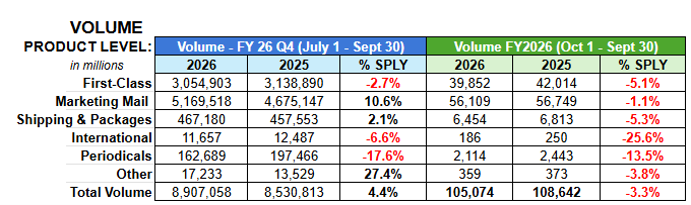
FY 26 Q4 Total mail and package volume grew 8.538 billion pieces to 8.907 billion pieces, a 4.4% growth over SPLY.
-
- Shipping and Packages: Revenue increased by 5%, volume grew 2.1%.
- Marketing Mail: Revenue grew 3% on a volume increase of 10.6%.
- First-Class Mail: Revenue rose 8%, while volume declined 2.7%.
- Periodicals revenue decreased by 6.6% on a volume decline of 17.6%.
USPS Liquidity Outlook
“Our liquidity remains insufficient to pay all obligations, to make capital investments necessary for continuity of operations, and to prepare for unexpected contingencies in the medium or long-term, without putting our ability to fulfill our primary mission at undue risk.”
USPS currently has no borrowing authority as they are at their $15 billion total debt limit. Add to that debt the interest on it of $8,354 B, the CSRS, FERS, workers compensation, leases, capital, and purchase obligations, as well as the RHB top up payments the total commitments of future cash obligations as of September 30, 2026, to $186,762 billion.
Capital Investments
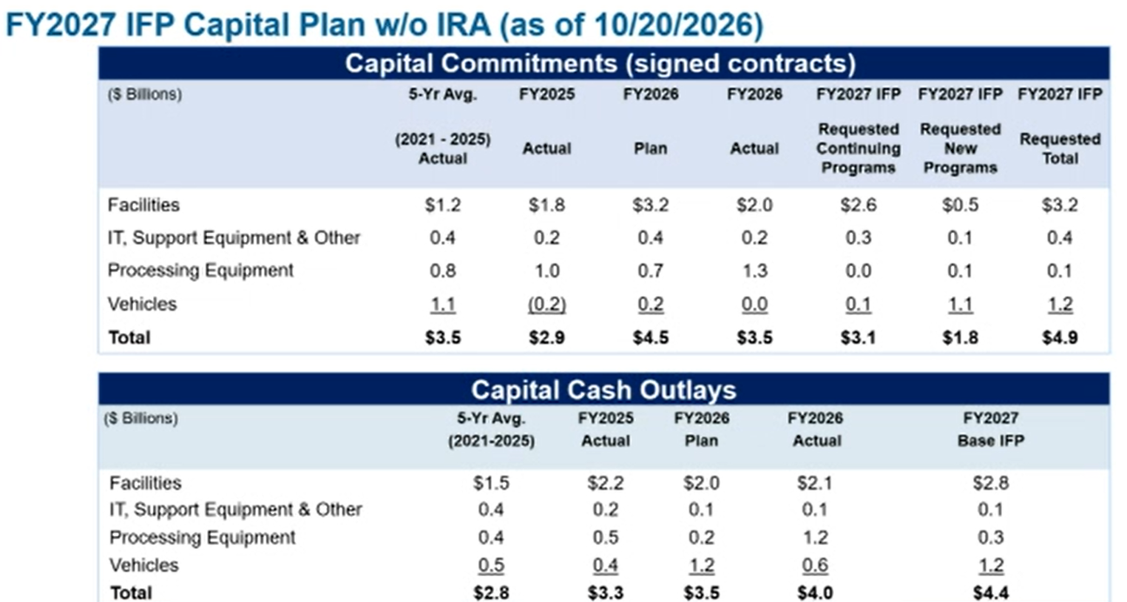
USPS currently estimate that the required cash outlays for capital investments necessary to ensure that they can continue to perform our universal service mission will amount to $4.8 billion in 2027, and an additional $15.8 billion for years 2028 through 2031.
Urgent Calls for Reform
Leadership, including Postmaster General David Steiner and CFO Luke Grossmann, stated that while internal measures improved performance, USPS’s financial situation remains critical under its current statutory framework. USPS continues to seek administrative and legislative reforms from Congress, including:
-
- Raising the statutory debt limit above $15.0 billion (unchanged since 1992). The ask is $34.5
- Reforming CSRS pension funding rules to rectify the historical liability between USPS and the U.S. Treasury using modern actuarial principles.
- Asset diversification, allowing USPS pension and retiree health funds to be invested in market-based instruments. The USPS OIG has estimated that if USPS had been permitted to invest in a portfolio of 60% equities / 40% bonds since its fund’s inception, total assets would have reached $1.2 trillion by the end of FY2022, compared to the actual balance of $298 billion (a difference of roughly $900 billion)
- Workers’ compensation reform adopting private-sector best practices.
- Relief or funding for congressionally mandated, uneconomic service requirements. (pay for the unfunded mandates of the USO)
Risks to USPS
Within its annual financials USPS outlined the risks and uncertainties that impact its operational and financial security across five primary categories:
-
- Structural & Mandate Constraints: By law, USPS must deliver universally to every address (which grew by 1.7 million points in 2026), but statutory price caps and regulatory limitations prevent it from setting rates that fully cover rising costs. Additionally, statutory restrictions prohibit USPS from freely expanding into new commercial markets.
- Core Volume Declines & High-Density Competition: Traditional profitable paper mail (First-Class and Periodicals) continues to decline due to digital alternatives. Concurrently, large e-commerce customers are insourcing and building out their own delivery networks, threatening USPS’s package growth.
- Extreme Balance Sheet Pressure: The organization has reached its statutory debt limit ($15.0 billion) and faces over $97 billion in underfunded pension and retiree health obligations. Because cash flows are constrained, USPS has had to preserve liquidity by defaulting on amortization payments and suspending bi-weekly FERS normal cost contributions.
- Uncontrollable Cost Volatility: Expenses are tied to mandatory inflation adjustments (union contract COLAs linked to CPI-W), market fluctuations in fuel prices, and unpredictable actuarial revaluations and discount-rate shifts in workers’ compensation and pension liabilities.
- USPS is in negotiations with two of its largest unions today on contracts that expired in 2025 & 2026. They have two additional union contracts set to expire in 2027.
- Operating & Technology Bottlenecks: Modernizing an aging vehicle fleet and nationwide facility infrastructure requires substantial capital USPS currently lacks. Operating at scale also leaves the network vulnerable to air-carrier disruptions, severe weather, physical and cybersecurity threats, and system access control deficiencies.
FY2027 Integrated Financial Plan
USPS will likely publish its full Integrated financial plan by the end of the month or in December. Today Chief Financial Officer and Executive Vice President Luke Grossmann did present some of their target numbers though. The revenue projection for FY2027 (October 1st, 2026 – September 30th, 2027) is $85.8 billion, which is a 2.8% planned growth over FY26 $83.4 billion. Gary Reblin, the new Chief Commercial Officer, told the MTAC audience in October his goal is to grow revenue by $3 billion.
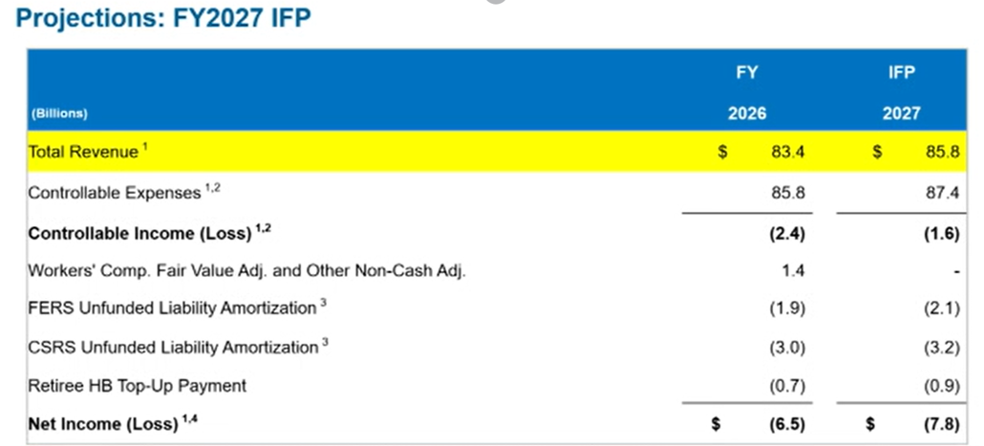
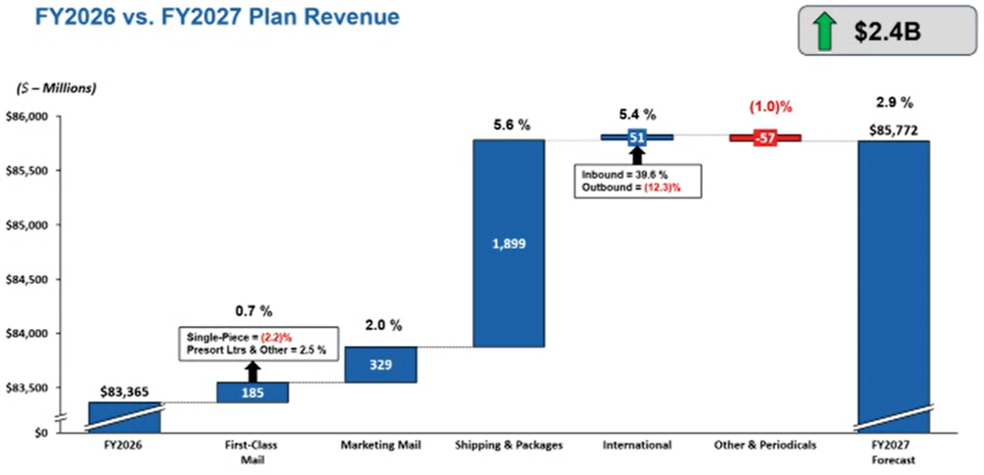
USPS has shared the class level revenue forecast but not yet the volume numbers but based on the expected postage increase in July 2027 each of the mail revenue numbers equates to a volume decline. They are showing an aggressive growth plan of 5.6% revenue for Packages.
Here is how their Capital Plan and cash outlays look.
Postal Power Shift: Election Update
How the Midterm Senate Could Decide USPS Funding, Rate Hikes, and Board Control.
The midterm elections have reshaped Washington’s balance of power, ushering in new legislative leadership, revised committee agendas, and a renewed debate over the future of the United States Postal Service (USPS). As the incoming Congress prepares to convene, the oversight committees in both the House and Senate will see fresh gavels—and with them, an appetite for rigorous accountability rather than unconditional financial relief.
Following the landmark Postal Service Reform Act (PSRA) of 2022, lawmakers envisioned a viable path toward self-sufficiency. Yet persistent declines in letter mail, inflationary operational pressures, and controversial processing consolidations under the 10-year “Delivering for America” plan have left the agency financially constrained. Despite frequent appeals from postal leadership and ratepayer coalitions, the likelihood of new direct appropriations or another sweeping reform bill passing in the near term is virtually zero.
Any attempt to move postal legislation through committee quickly collapses under competing demands:
-
- Reform proponents want subsidies or statutory debt relief.
- Fiscal watchdogs demand workforce reductions (not happening in this Congress), concessions on six-day delivery mandates (highly contentious topic), or limits on capital spending.
- Rural lawmakers demand statutory freezes on facility consolidations and strict, enforceable on-time delivery benchmarks. With these factions in opposition, forging a compromise that can clear both chambers and survive a Senate filibuster is extraordinarily difficult.
With these factions locked in opposition, building a compromise capable of clearing both chambers and surviving a Senate filibuster is an uphill battle. At most, lawmakers are likely to rely on narrow, defensive riders attached to annual government funding bills—such as safeguarding six-day mail delivery or temporarily pausing processing plant consolidations rather than advancing standalone reform.
The most consequential battleground will not be the hearing room floor, but the Senate executive calendar: the stalled confirmation slates for both the USPS Board of Governors (BOG) and the Postal Regulatory Commission (PRC).
The Board of Governors: Five Empty Chairs
The USPS Board of Governors functions much like a corporate board of directors, holding fiduciary oversight, selecting the Postmaster General, approving billion-dollar capital outlays, and reviewing rate adjustments. By statute (39 U.S.C. § 202), the Board consists of nine presidentially appointed, Senate-confirmed Governors, with no more than five permitted from the same political party. Currently, the Board is dangerously depleted, operating with five vacancies:
| Name | Role | Political Party | Term Expiration Date |
| Amber F. McReynolds | 2026 Chair | Independent | December 8, 2026 (Eligible for holdover to Dec 2027) |
| Dan M. Tangherlini | Governor (new 2027 Chair) | Democratic | December 8, 2027 |
| Derek T. Kan | 2026 & 2027 Vice Chairman | Republican | December 8, 2028 |
| Ronald A. Stroman | Governor | Democratic | December 8, 2028 |
| Two Vacancies | Governor & Governor | — | Both seats Expired Dec 8, 2023 (Seat runs through 2029) |
| Vacant | Governor | — | Expired Dec 8, 2024 (Seat runs through 2030) |
| Vacant | Governor | — | Expired Dec 8, 2025 (Seat runs through 2031) |
| Vacant | Governor | — | Vacated 2025 (Seat runs through 2032) |
The White House sent four nominees to the Senate Committee on Homeland Security and Governmental Affairs (HSGAC) to fill these seats:
| Nominee | State | Party / Affiliation | Term Expiration Date | Status / Notes |
| Anthony Lomangino | Florida | Republican | December 8, 2031 | Nominated January 2026 |
| Jeffrey Brodsky | Florida | Republican | December 8, 2029 | Nominated March 2026 |
| William Gallo | Florida | Republican | December 8, 2030 | Nominated March 2026 |
| Robert Steffens | Texas | Republican | December 8, 2032 | Nominated March 2026 |
Because all four nominees are registered Republicans, the package drew swift pushback from Senate leadership for bypassing the long-standing tradition of advancing paired, bipartisan slates negotiated with the minority party. With Democrats holding the Senate majority, committee action on an all-Republican slate has ground to a complete standstill. Unless the White House re-opens negotiations to submit a balanced slate, these seats risk staying vacant well into the next administration.
The Postal Regulatory Commission: Split-Vote Risk
A parallel stalemate is brewing at the Postal Regulatory Commission (PRC). While the Board of Governors dictates internal strategy, the independent PRC acts as the public watchdog and rate regulator—holding statutory authority over price caps, network service standard modifications, and ratepayer complaints.
Under 39 U.S.C. § 502, the Commission consists of five members serving staggered six-year terms, capped at three members from any single political party.
Following the departure of former Chairman Michael Kubayanda, the PRC is operating with just four commissioners:
| Commissioner | Role | Political Party | Term Expiration Date |
| Robert G. Taub | Vice Chairman | Republican | October 14, 2028 |
| Thomas G. Day | Commissioner | Independent | October 14, 2028 |
| Ann C. Fisher | Commissioner | Republican | October 14, 2030 |
| Ashley E. Poling | Commissioner | Democratic | November 22, 2030 |
| Vacant (seat formerly held by Michael Kubayanda) | Chairman | Democratic | November 22, 2026 |
The White House nominated Jeffrey Zisk (Republican) to fill Kubayanda’s vacancy for both the remainder of the term ending in November 2026 and the subsequent six-year term running through 2032.
Referred to Senate HSGAC on September 28, 2026, the nomination remains stalled with no confirmation hearing scheduled. Beyond broader partisan friction, confirming Zisk would push the commission to a 3-1-1 Republican majority on a seat historically held by a Democrat, further hardening Senate opposition. In the interim, an even-numbered four-member panel leaves the regulatory body exposed to 2–2 deadlocks on critical rate and compliance decisions.
Why Leaving These Seats Empty Matters
Leaving both bodies understaffed carries direct consequences for the American public and the postal ecosystem:
-
- Weakened Oversight from Within: The Board of Governors requires six members for an ordinary statutory quorum. Operating on the razor’s edge of minimum staffing leaves the agency one illness, resignation, or recusal away from governance paralysis, hamstringing its ability to approve major contracts and evaluate postal leadership.
- Compromised Regulatory Accountability: An understaffed PRC faces strict statutory deadlines to review bi-annual rate hikes, evaluate complex cost-allocation formulas, and deliver advisory opinions on nationwide delivery changes. Split votes risk stalling formal orders and delaying critical ratepayer protections.
- Unchecked Operational Shifts: With Congress unwilling to fund bailouts and the Board lacking a full bench, postal management retains broad latitude to push forward aggressive network consolidations and cost-cutting measures without robust, diverse scrutiny.
Without confirmed leaders to set postal policy from within and a fully seated commission to regulate it from without, the Postal Service risks entering an extended period of administrative paralysis. Ultimately, as political gridlock leaves confirmation slates frozen in committee, it is American consumers and businesses who will bear the cost—facing escalating postage rates, strained delivery standards, and a critical public infrastructure operating without a full team at the helm.
E-Delivery, digital migration update
SEC Proposed Regulation E-Delivery: officially introduced on July 16, 2026, shifts default delivery for financial disclosures to electronic. Investors must opt out to receive paper. Estimated loss of 2.5 to 3+ billion First-Class mail pieces annually, representing $1.5 B in Postal revenue.
Department Of Labor Group Health Plan E-Delivery: Expands electronic disclosure options for group health plan administrators. Estimated impact: moderate decrease in health-benefit-related First-Class mailings, eleven billion sheets of paper annually, representing $1.5 B in Postal revenue.
Both proposals represent a massive shift from an “opt-in” paper-first framework to an “opt-out” electronic default regime for these types of communications.
Status of the Proposed Rules:
Comments on both e-delivery proposals closed September 21. Both remain proposed, and neither agency has announced a final rule date.
While the industry awaits a determination of a final rule, they continue to communicate their concerns of consequential negative impact to American communities and the United States Postal Service to Congress, the SEC, and the DOL in the hope of modifications or elimination of rule mandates.
The Protect Paper Choice Coalition (PPCC) is an advocacy alliance formed to preserve the right of Americans to choose physical paper communications over mandatory electronic-only (e-delivery) default rules.
Interested parties looking to become involved in efforts to mobilize against proposed federal rules like these should consider supporting the Protect Paper Choice Coalition.
Nearly 80% of Americans say they want the right to decide how they receive financial and service communications. The people most affected by losing that choice are often the least equipped to navigate the switch.
The Envelope Manufacturers Association (EMA) Foundation has collected some extremely persuasive statistics concerning people’s choice of paper, and the impacts to our communities beyond the possible consequential loss of mail volume. Please do share these numbers when speaking with your congressional and senate representatives.
Americans face a growing risk of financial exposure through fraud, cybercrime, and the loss of physical records. Digital records are vulnerable in ways paper is not.
-
- 65% of Americans are increasingly worried their personal data held electronically is at risk of being hacked, stolen, lost, or damaged
- 84% of consumers read physical mail the same day it arrives — meaning critical financial and legal notices are far less likely to be missed
- 56% of households that receive paper bills cite recordkeeping as their primary reason
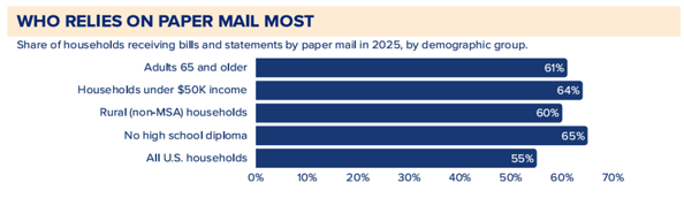
Seniors ages 65 and over represent the fastest-growing segment of the U.S. population and disproportionately rely on paper mail for bills statements and government correspondence. Seniors have the lowest broadband and internet adoption rates of any age group.
-
- 61% of households headed by someone 65+ still received bills and statements by paper mail in 2025
- 32% of seniors lack wireline broadband at home, about 19 million older Americans cut off from digital-only communications
- $2.4B in fraud losses reported by adults 60+ to the FTC in 2024 — up 300% since 2020.
- 22% of U.S. households — about 30 million — do not subscribe to broadband internet at home
- 64% of households earning under $50K received bills and statements by paper mail in 2025
- ~1 in 3 Americans without broadband say the reason is that they cannot afford it
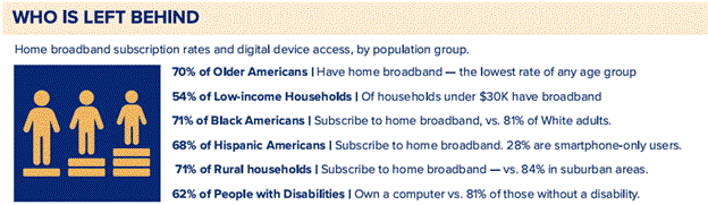
Protect your paper choice https://www.protectpaperchoice.org/
Data Citations: Pew Research Center (2021 & 2026) · USPS Household Mail Survey FY2025 · U.S. Government Accountability Office (2023) Federal Trade Commission. Consumer Sentinel Network Data Book 2024, Two Sides North America (2025), USPS Household Mail Survey FY2025, OATS from AARP — Aging Connected 2025, Pew Research Center (2022), Protecting Older Consumers 2024–2025 Report, Lob & Pure Spectrum (2025) All statistics reflect the most current publicly available research as of May 2026. For research and advocacy purposes only.
Postage Rate Setting
Twenty Years of History, 2006 to 2026
For businesses and direct mailers, tracking postal rate history is critical to understanding how predictable budgeting was replaced by aggressive, compounding price adjustments. These milestones explain why postage rates shifted from strict CPI limits.
-
- December 2006: Congress passed the Postal Accountability and Enhancement Act (PAEA) This law created modern market-dominant ratemaking and formally established the rule that annual price increases could not exceed changes in the CPI-U.
- May 2008: (First CPI-Capped Price Increase): The first price increase implemented under the PAEA’s CPI cap took effect on May 12, 2008 (Docket No. R2008-1), which raised the First-Class letter rate from 41 cents to 42 cents.
- 2014: USPS implemented an exigent rate increase. Under 39 U.S.C. § 3622(d)(1)(E), USPS can petition the Postal Regulatory Commission (PRC) to exceed the CPI price cap due to “extraordinary or exceptional circumstances.” USPS sought an exigent increase to recover mail volume and revenue losses caused by the Great Recession of 2008–2009.
- The exigency rule is temporary in nature and meant only to recover a capped dollar amount of recession losses ($4.6 billion). Once that threshold was reached, the surcharge was lifted on April 10, 2016, which forced the price of a stamp down from 49 cents back to 47 cents (a rare postal rate decrease).
- November 2020, the Postal Regulatory Commission (PRC) issued Order No. 5763 which overhauled market-dominant pricing by embedding automatic above-CPI pricing formulas directly into standard rate authority. Density-based rate factor, Retirement obligation (now eliminated), and the non-compensatory rate authority.
- June 2025: RM2024-4 Market Dominant Rate Authority: Two rules issued since the November 2020 Order No. 5763, (8893 & 9426), limiting USPS to one rate increase per fiscal year, and limiting USPS ability to lower the presort discount from its current spread if it is in the 85% – 100% band.
- December 2025: USPS files a petition to modify the ratemaking system giving two options.
- For the next five years, remove the CPI cap and density factor, allow the Board of Governors to establish the rates providing a one-year notice of plan to increase, and a nine-month notice of the percent change by product.
- Leave the current system in place but provide the postal service an additional 22% they may use over a five-year period.
- January 2026: Order 9427 from the PRC invites interested parties to submit petitions for modifications of the ratemaking system.
What’s Next?
PRC is reviewing the USPS and Industry petitions and will be issuing new rules to modify the current rate making system.
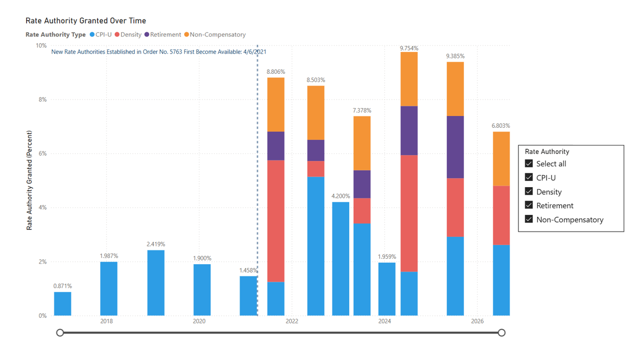
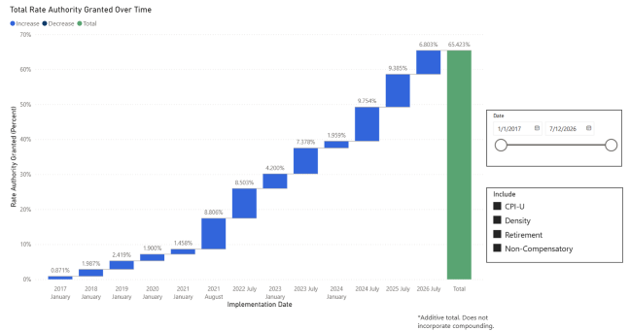
Whatever rules the PRC settles on next will establish the playing field for the coming decade. The Postal Regulatory Commission hosts a BI dashboard showing visuals of the rate authority history, what was provided to USPS and what USPS used.
This view displays the last decade of rate authority granted to USPS.
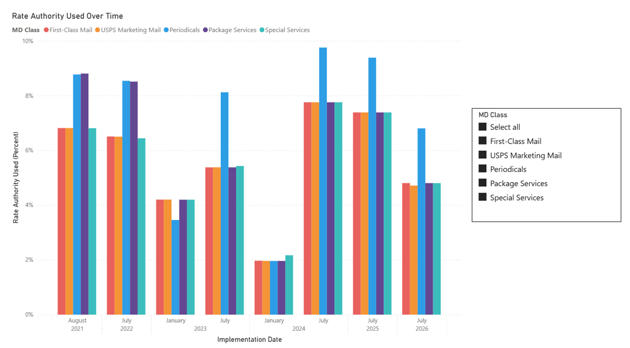
Now looking at how those numbers have stacked up over that same period.
And finally, the amount of that authority that USPS has used since the November 2020 rule allowing additional factors over CPI.
Section 2: Operations
Mail Not in Measurement
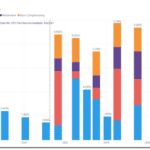
4.2 billion Mailpieces Excluded from USPS Performance Scores in FY26 Q4
Every quarter, the United States Postal Service (USPS) reports its on-time delivery scores to the Postal Regulatory Commission (PRC) and the mailing public. While these percentages measure speed and reliability, part of the story lies in what gets left out of the equation.
In the fourth quarter of Fiscal Year 2026 (FY26 Q4), 4,223,245,439 mailpieces were excluded from internal Service Performance Measurement (SPM). Although total quarterly exclusions dropped from 4.79 billion in Q1 to 4.22 billion in Q4, billions of pieces remain unaccounted for in the reports.
FY26 Unique Exclusions by Class
| Mail Class | FY26 Q1 | FY26 Q2 | FY26 Q3 | FY26 Q4 |
| First-Class Mail | 2,191,684,867 | 2,296,053,116 | 2,008,773,428 | 1,649,901,904 |
| USPS Marketing Mail | 2,415,557,980 | 2,067,410,004 | 2,193,895,953 | 2,399,073,510 |
| Periodicals | 175,471,177 | 165,290,108 | 168,351,726 | 173,449,846 |
| Package Services (BPM Flats) | 2,290,240 | 6,974,864 | 1,923,844 | 820,179 |
| Total Unique Excluded Pieces | 4,785,004,264 | 4,535,728,092 | 4,372,944,951 | 4,223,245,439 |
Source: USPS Service Performance Measurement Exclusion Breakdown (FY26 Q4)
Individual pieces can be flagged for multiple issues, but exclusions are heavily concentrated in two areas:
-
- “No Start-the-Clock” (Dock & Container Gaps): Missing container unload scans or failures to match containers with Facility Access and Shipment Tracking (FAST) appointments accounted for0% of First-Class exclusions (1.01B pieces) and 50.9% of Marketing Mail exclusions (1.28B pieces). Even with valid barcodes on individual pieces, dock-level gaps pull whole containers out of measurement.
- “No Piece Scan” (Automation Dropouts): Mail moving in the network without an automation scan accounted for 2% of Periodical exclusions (77.0M pieces), 46.2% of Package Services flats (406K pieces), and 25.0% of Marketing Mail (628.0M pieces). Flats continue to suffer from the “No Piece Scan” penalty. This underscores ongoing operational limitations in automated flat processing compared to high-speed letter sorters.
No Start the Clock – The Largest Issue
For commercial and presorted mailings, the entry event is tracked at the container level (pallets, rolling stock, or trays labeled with an Intelligent Mail container barcode, or IMcb) rather than by scanning each letter individually.
According to the Postal Service’s reporting documentation, mail falls into the “No Start-the-Clock” exclusion category due to two primary root causes:
-
- NO SCAN: If a postal worker skips scanning the container barcode, if the barcode placard is damaged or unscannable, or if the container bypasses the standard dock intake process, no unload scan is recorded. Without the scan, the system cannot confirm the exact date and time the mail entered USPS possession.
- INABILITY TO LINK the FAST appointment: When the container is scanned at the dock, USPS software attempts to automatically match that container’s IMcb to the corresponding electronic FAST appointment and postage statement.
If this link fails—such as when:
-
- A shipment arrives without an appointment or outside its scheduled appointment window,
- The FAST appointment ID entered in eDoc does not match the actual physical shipment paperwork.
the system cannot establish an official, authenticated acceptance time.
Exclusions are not just a measure of delivery speed; they reflect USPS’s visibility performance. For regulators and mailers, the data proves that performance scores only tell part of the story—as long as dock unload tracking and flat-sorting automation struggle, over 4 billion mailpieces a quarter effectively remain invisible to official service standards.
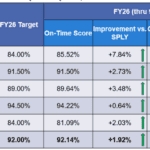
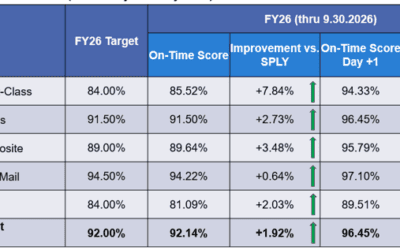
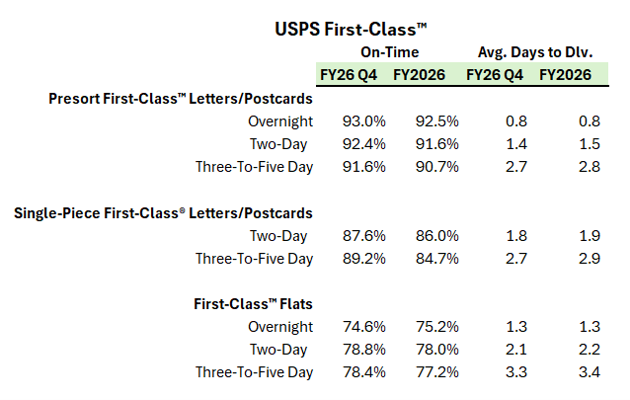
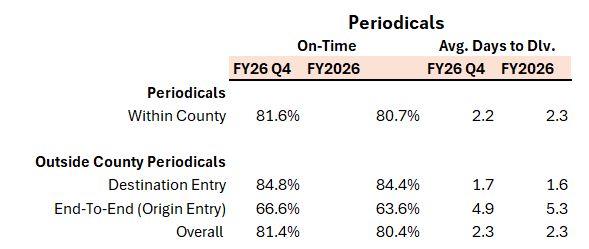
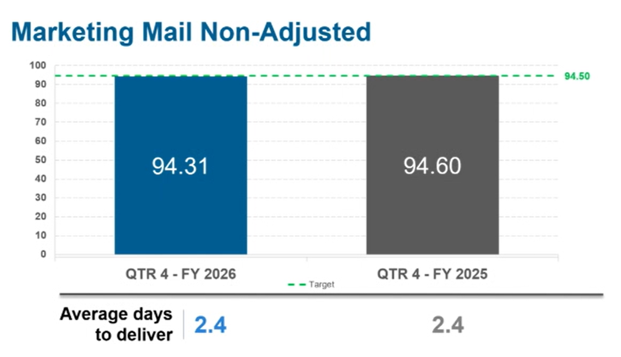
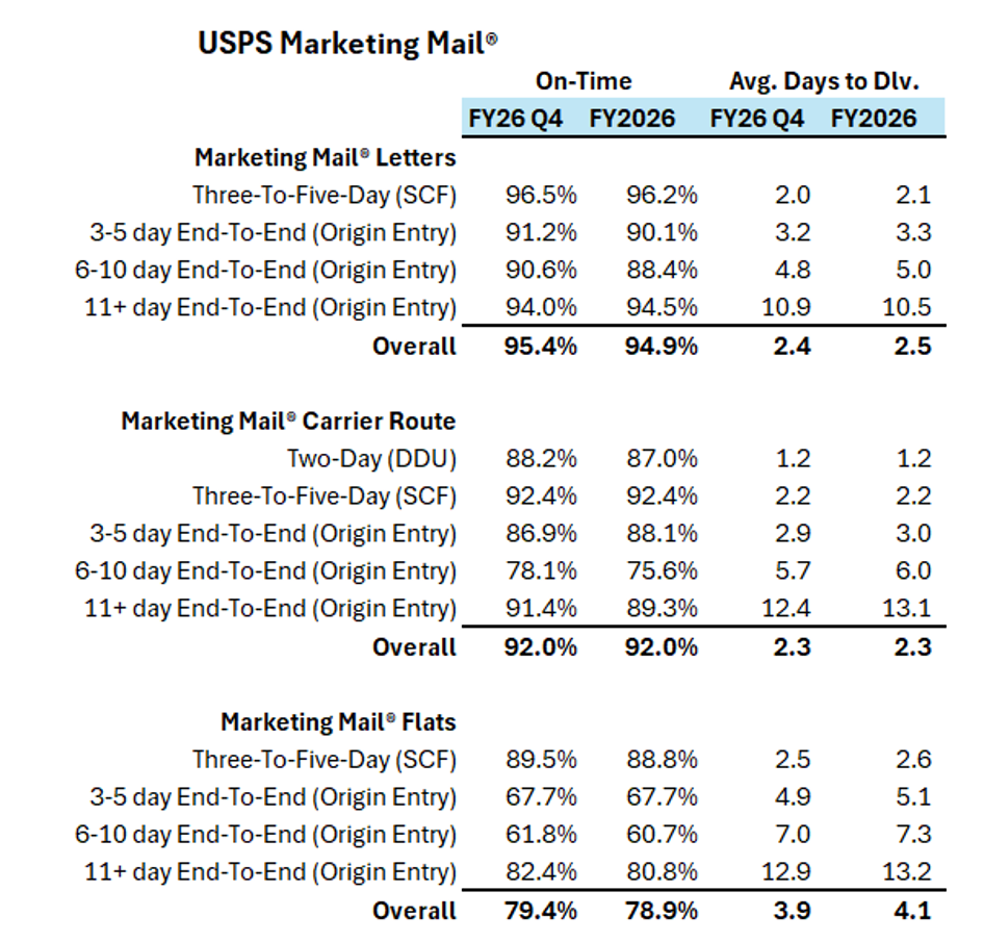
Quarter Four and FY2026 Service Performance Scores
To see the scores for Marketing Mail and First-Class at a District and Area Level you can download the reports on the PRC site.
The Aggregate First-Class below includes presort, single piece as letters, cards, and flats.
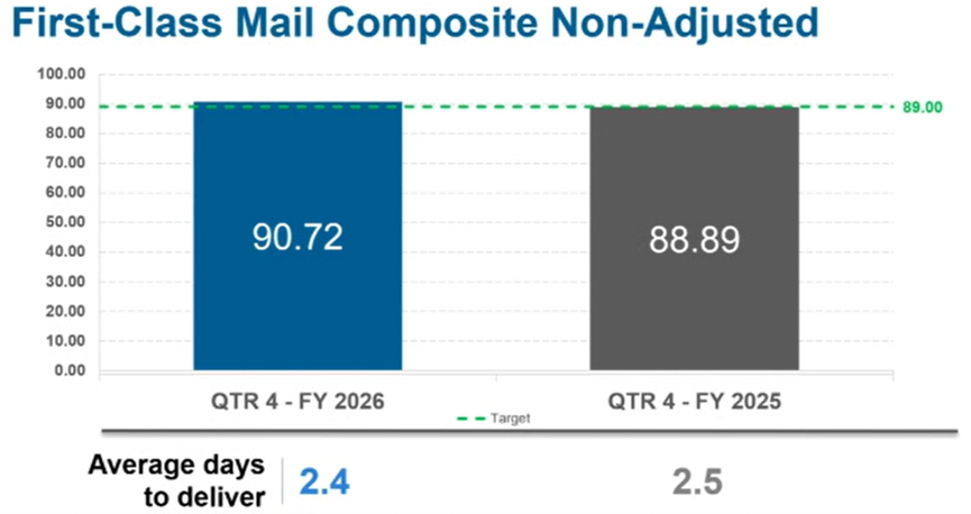
The Periodical Scores are not broken out by District and Area.
The aggregate Marketing Mail below includes Letters, Flats, and Carrier Route, as it is both destination entered and origin entered.
All Service Performance Data for FY26 is posted to the PRC web site.
https://prc.arkcase.com/portal/filings/141224
Color Codes, Critical Entry Times (CETs), and Dropship vs. Origin Operations
In high-volume mail production and logistics, understanding when a mailpiece will hit the mailbox is essential for driving customer engagement, coordinating omnichannel touchpoints, and meeting in-home target windows.
Within the United States Postal Service (USPS), delivery commitments are managed by a standardized, visual: the National Marketing Mail Color Code Policy. By pairing Critical Entry Times (CETs) with physical, color-coded placards and tags, USPS processing plants and delivery units ensure first-in, first-out discipline and establish processing and delivery schedules.
Whether you are dropping destination mail at a Sectional Center Facility (SCF) / Local Processing Center (LPC) or induct mail locally at an origin Business Mail Entry Unit (BMEU), understanding how this process works is critical to planning your induction schedule to meet in home windows.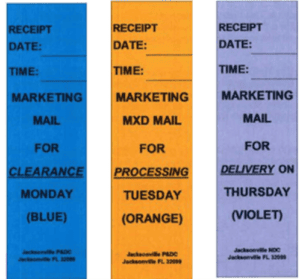
- The Clock Starts: Critical Entry Times (CET) and Day of Receipt
Before a color code tag is applied to a pallet or inserted into a tray sleeve, USPS determines the Day of Receipt based on the National Critical Entry Times:
-
- Origin Entry (BMEU / Local Entry): The national CET is 15:00 (3:00 PM).
- Destination Drop Ship (DSCF / LPC / DU): The national CET is 16:00 (4:00 PM).
How the CET Rule Works
-
- Accepted ON or BEFORE the CET: The actual calendar day of drop is treated as the official Day of Receipt.
- Accepted AFTER the CET: The mailing is rolled over; its official arrival date advances to the following applicable processing day.
Every tag applied is supposed to physically show both the actual date and time of arrival and the identifying facility, preventing mail from being prematurely aged or artificially delayed.
Destination Entry: Drop Shipping to an SCF, LPC, or P&DC (DSCF)
- Destination drops shipment bypasses origin processing facilities and deposits mail directly into the destinating plant (DSCF, LPC, P&DC).
- For mail entered under destination SCF rates (DSCF 3-digit, 5-digit, or Carrier Route), facilities apply a Delivery Color Code based on a 16:00 CET:
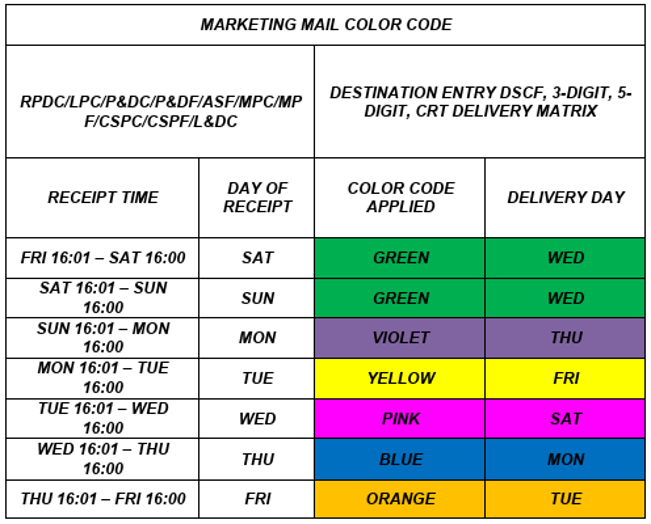
Key Takeaways for DSCF Drop Shippers:
- The “Green” Weekend Buffer: Mail dropped before 16:00 on Saturday and mail dropped on Sunday both receive a green tag with a Wednesday delivery commitment. Dropping by Friday 16:00 buys an extra day (Tuesday delivery via an orange tag).
- Thursday Drops Hit Monday: Drop-shipping on Thursday before 16:00 commits the mail for delivery the following Monday using a blue tag.
Local & Origin Entry: Inducting via BMEU / DMU
When mailers enter Marketing Mail locally at an origin facility (via a BMEU, Detached Mail Unit [DMU], or origin DDU), the mail undergoes a two-step process:
- Outgoing Clearance: The entire mailing is initially tagged with a 1-Day Clearance Color Code based on a 15:00 CET. This marks when the plant must process and clear the mail out to downstream RPDCs/LPCs or consolidation hubs.
- Origin Turnaround Extraction: Any volume identified during processing that belongs to the local service area (known as Turnaround Mail) has its clearance tag removed and replaced with an Origin Turnaround Delivery Tag (same colors as destination entered mail to that facility).
The delivery date applied to local turnaround mail is tied to the original entry date and time, not when it was extracted from the sorting machines.
Critical Distinctions: Local Turnaround vs. Destination Entry
- The 15:00 Cutoff: You have an hour less on origin entries (15:00) than destination drop shipments (16:00) to secure that calendar day’s receipt.
- Friday Inductions: At origin entry, both Thursday and Friday afternoon drops end up with a blue tag targeting Monday delivery, because Sunday processing operations are constrained for non-turnaround Marketing Mail.
Crucial Operational Rules Mailers Need to Know
- Oldest Mail First: Postal operations run strictly in color sequence, where the oldest color commitments must be staged and fed into sorters ahead of newer commitments. Delayed mail arriving from upstream nodes must be queued ahead of current volume.
- Missing or Conflicting Tags: If a pallet arrives without a tag, postal employees are instructed to apply the color code of the oldest mail currently in the facility. If conflicting tags are discovered, the oldest date tag always takes precedence.
- Commingled Upgrades: If Marketing Mail is accidentally commingled with First-Class Mail so that it loses its individual identity, the entire container is upgraded and treated under First-Class standards.
Section 3: Industry & USPS News and Events
Inside USPS Informed Greetings
I typically dedicate these pages to commercial mailing operations—high-volume logistics, postage, processing, and direct mail strategies.
Today’s piece is a slight departure from my standard B2B & B2C coverage, but it offers a fascinating look at how the very tools that we use in our industry for business mailings are being repurposed for the everyday household. I thought this might interest a few of you.
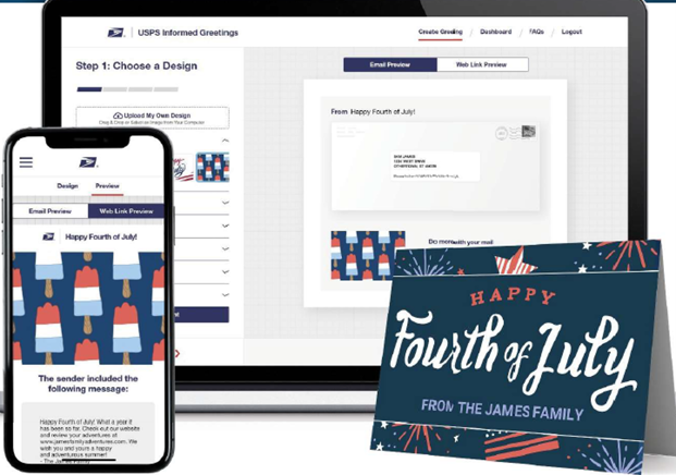
Informed Greetings (informedgreetings.usps.com) deserves a review.

Beyond the discount opportunity, direct marketers have leveraged Informed Delivery interactive campaigns to turn standard gray scale envelope images into digital touchpoints using clickable ride-along’s, and full color representative images of their mail pieces.
Informed Greetings uses that exact infrastructure for individual consumers sending single cards, holiday mailings, or wedding invitations.
Instead of receiving only a flat, grayscale machine scan of incoming mail, enrolled recipients get a vibrant, personalized digital preview delivered to their inbox the morning the physical card arrives at their mailbox.
How It Works in Practice
It is a four-step workflow that relies entirely on standard home office equipment and retail postage, simple for any user to complete at home!
- Pick a Design: Select from over one hundred pre-made card templates or upload custom imagery.
- Add Addresses: Enter individual details or upload a .csv list for bulk occasions like weddings or holidays; addresses are validated via the USPS Address Management System (AMS).
- Personalize: Add custom notes, event links (such as gift registries or RSVP pages), and styled label fonts.
- Print and Mail: Print recipient labels on standard sheets (e.g., Avery 5160), affix them alongside postage stamps, and drop the envelopes in the mail.
- The Arrival: On delivery day, the recipient sees the colorful digital greeting inside their Informed Delivery Daily Digest email before carrier drop-off.
Why It Matters to the Mailing Industry
While Informed Greetings is designed for personal greeting cards, it demonstrates how postal APIs can put complicated validation, serialization, and tracking rules into frictionless self-service experiences.
As the line between digital notifications and physical touchpoints continues to blur, the technologies driving large-scale direct mail are proving just as effective at deepening personal connections—one envelope at a time.
USPS Appointments and Retirements
The United States Postal Service announced the appointment of Fiona Machado to the position of Vice President, Regulatory Pricing and Costing. Fiona has been in the role of acting Vice President of Pricing and Costing since the retirement of Sharen Owens last April. Fiona started with the Postal Service in 2013 as a part of the Management Intern Program as a data analyst in Statistical Programs. Her executive career began in 2021 when she was promoted to the Director of Revenue and Volume Reporting, a role in which she enhanced the precision of the Revenue, Pieces and Weight (RPW) financial reporting.
USPS announced the upcoming retirement of Vice President of Government Relations and Public Policy, Peter Pastre. His retirement will be effective at the end of the year December 31st, 2026. The postal service has not yet announced who will replace him. Peter has become much more engaged with the industry over the last few months as USPS prepared its Congressional asks for 2027 and beyond.
USPS and Industry Events
GrayHair will be presenting or in attendance at all events listed in red. If you will be attending, please let your GrayHair representative know so we can plan to meet up!
2027
Winter MTAC January 26th – 27th, Washington, D.C.
NAPM Annual Conference, February 15th-18th, Orlando, FL
DTAC Spring Meeting, March 2nd-3rd, Savannah, GA
Spring MTAC April 20th – 21st, Washington, D.C.
National Postal Forum, May 16th-18th, Orlando, FL
PostCom Summer Meeting, June 8th-9th, Washington, D.C.
DTAC Summer Meeting, June 9th – 10th, Washington, D.C.
Summer MTAC July 20th – 21st, Washington, D.C.
DTAC Fall Meeting, September 8th – 9th, Chanhassen, MN
PostCom Fall Meeting, September 21st – 22nd, Alexandria, VA
For more information on these topics or other postal issues contact GrayHair Software at engage@grayhairsoftware.com