
KEY HIGHLIGHTS
- August Financials: With the 2026 fiscal year near its close there is a positive trend in marketing mail volume, but not enough to offset a significant milestone ahead.
- Pilots: Two major pilots kicking off this week with possible consequence for USPS.
- USPS OIG: Billions in lost revenue identified through counterfeit postage.
- Federal Agencies Digital First: SEC and DOL proposed rule changes with possible substantial postage impact.
Section 1: Financial & Regulatory Outlook
USPS August 2026 Unaudited Financials
USPS August 2026 Financial and Volume Report: Key Takeaways
Key Financial Highlights
- Total Operating Revenue: Stood at $6.75 billion for the month, representing a 4.0% increase compared to same period last year (SPLY) ($6.49 billion) and matching plan.
- Net Loss: The Postal Service reported a net loss of $867 million for the month; a 5.4% improvement compared to the $917 million net loss recorded SPLY.
- Controllable Loss: Excluding non-controllable items (such as workers’ compensation adjustments and retiree liability amortization), the controllable loss came in at $362 million (a 6.9% improvement vs. SPLY).
- Workhour Productivity: Total workhours for August 2026 came in at 93 million hours, a 6% reduction compared to SPLY (and 2.4% below planned workhours).
- Total Operating Expenses: Reached $7.61 billion, up 2.5% from SPLY ($7.43 billion).
- Transportation Costs: Grew by 7.8% year-over- year to $742 million.
- First-Class Contraction: First-Class Mail continues to see volume erosion, down 4% year-over-year, which led to a 2.9% decline in First-Class revenue.
- Marketing Mail Growth: Marketing Mail rebounded with a 7% volume increase and a 5.5% revenue jump year-over-year.
- Shipping & Package Strength: Shipping and Packages revenue surged 3% to $2.75 billion on flat volume (+0.3%), due in part to the temporary 8% fuel surcharge.

Mail and Package Volume Trends
Total volume across all product lines dropped 1.1% year-over-year, coming in at 8.3 billion pieces, year to date is still down 3.9% at 96.1 billion pieces.
Fiscal Year 2026 comes to a close this week on September 30. While official volume figures will not be published until early November, they are expected to mark another significant milestone in Postal history. Unless September mail volume surges by 20% compared to last year, total annual volume will fall below 100 billion pieces for the first time since 1979—forty-seven years ago. This represents a historic shift, with USPS mail volume now less than half of its peak of over 200 billion pieces in 2006.

2027 Postage Projections
PRC Order No. 9696 denied USPS request to use an estimated density factor in January 2027. That would then leave USPS with only the Consumer Price Index (CPI) to use for a Market Dominant (MD) postage increase in January 2027, the CPI total allowable to them is at 1.881% for Marketing Mail and 1.792% for the other classes of Mail. Current rules limit the Postal Service to one MD increase per fiscal year, so if USPS takes a January increase, they would not be eligible again for an increase until October 1st, 2027.

USPS has given us the forward guidance that they will NOT be filing in October for a January 2027 MD postage increase and instead file for an increase in April 2027 for a July 18th, 2027, effective date.
The current estimates being used today for budgeting is to expect an increase in the range of 6 – 6.5%. USPS is using the figures of 3.4% for an annualized CPI factor and 2.8% for an estimated density factor. The Annual Compliance Report expected on December 29th will confirm their density factor calculations, which I believe will be lower than the current estimate of 2.8%.

Postmaster General Steiner Addresses PostCom
At last week’s Fall 2026 PostCom study day meeting the PMG and the Vice President of Government Relations and Public Policy Peter Pastre discussed the current USPS financial status and its asks from Congress.
The three main things USPS identifies that they need from Congress to get relief from its uncontrollable costs are:
- Increase of the borrowing authority from $15B to $34.5B (they have exhausted the $15B) (shouldn’t score because USPS makes interest payments over 10 years)
- Retirement investment flexibility (private investments beyond current T-Bills) – (will score big due to concerns if market drops and the government then has to pay the pensions)
- Financial support for unmandated USO requirements (Congressional appropriations) A difficult ask for all to get behind without some agreed guiding principles
USPS and its Board of Governors are prioritizing an increase in borrowing authority during this Congress, signaling House committees that they will also request raising the annual borrowing cap from $3B to $5B. This increase is intended to stabilize finances without requiring another pension plan loan, allowing leadership to focus on long-term policy reforms. If Congress fails to pass this by year-end, USPS warned of potential post-peak operational shifts in mid-February—most notably closing roughly 10,000 post offices and slowing deliveries.
Both of these actions are the two most feared from Congress and Senate, as constituent concerns heavily center on slow mail and local post office closures.
Regarding Election Mail, leadership welcomed stability for the current cycle while advocating for future standardized ballot envelopes, logos, and IMbs. Citing a recent incident in Utah where an employee discarded mail, leadership highlighted the need for state-authorized voter manifest tracking to verify ballot receipt.
Federal E-Delivery Threats
The Security and Exchange Commission (SEC) Proposed Regulation E-Delivery: Shifts default delivery for financial disclosures to electronic. Investors must opt out to receive paper. Estimated loss of 2.5 to 3+ billion First-Class mail pieces annually, representing $1.5 billion in Postal revenue.
Department Of Labor (DOL) Group Health Plan E-Delivery: Expands electronic disclosure options for group health plan administrators. Estimated impact: moderate decrease in health-benefit-related First-Class mailings, 11 billion sheets of paper annually, representing $1.5 billion in Postal revenue.
The Protect Paper Choice Collation stood up to advocate for keeping paper mail delivery the default for both the SEC financial disclosures and the DOL group health plan mailings. They cite multiple reasons beyond protecting USPS revenue and volumes as reasons to oppose these and other digital migration rule changes.
Below is from their web site.
Nearly 80% of Americans say they want the right to decide how they receive financial and service communications. The people most affected by losing that choice are often the least equipped to navigate the switch:
- 18% of Americans are 65 or older, but only 14% report being online almost constantly.
- Nearly 28% of people in rural areas — and more than 23% of people on Tribal lands — lack access to fixed broadband, according to the FCC.
- 22% of Americans have been victims of identity theft, most commonly financial identity theft.
- Older Americans filed more than 48,000 phishing complaints with the FBI last year alone.
Comments were received on both proposed rules last week on September 21st. Now that the public comment periods have closed for the proposed SEC Regulation E-Delivery and the DOL ERISA Group Health Plan E-Delivery Safe Harbor rules, both agencies transition from receiving public feedback to finalizing administrative rulemaking.
If the SEC proposal becomes a final rule the effective date would typically be set for 60 days after publication in the Federal Register. The SEC proposed a two-year transition period following the effective date before old e-delivery guidance is fully rescinded, allowing covered entities time to issue initial paper notices and establish opt-out systems.
If the DOL rule becomes final its effective date would be the first day of the first calendar year following publication of the final rule (e.g., as early as January 1, 2027, if finalized late in the calendar year).
Section 2: Operational Pilots & Network Transformation
Marketing Mail Optimized Delivery (MMOD)
Today, September 28th, the USPS launched a pilot in two cities, Austin, TX, and Boston, MA called Marketing Mail Optimized Delivery (MMOD). The test will run for four weeks through October 23rd involving the following ZIP Codes: 78703, 78751, and 02128, 02129, 02152, 02143, 02144, 02145, 02149, and 02150.
The proof-of-concept program called Marketing Mail Optimized Delivery (MMOD) is designed to streamline operations and curb labor costs in an era of shifting mail volumes; the pilot explores deferring marketing mail delivery to address points that are not slated to receive First-Class Mail on a given day.
Below is an overview of how the pilot operates, based on notes shared last week at the fall Delivery Technology Advocacy Council (DTAC) meeting.
How the MMOD System Works
The core mechanics of the MMOD program center on automated sorting equipment during daily mail processing:
- First Pass (Operation 918) & Second Pass (Operation 919): All letter mail is run through a first sorting pass. During the second pass (Operation 919), the sorting machinery determines whether a specific delivery point (a house or business) has any First-Class Mail scheduled for delivery that day.
- Selective Hold Out: If a delivery point has no First-Class Mail, any Marketing Mail letters for that address are diverted into a specialized pocket on the machine, only if the piece is identified to be in advance of its delivery service standard.
- 24-Hour Deferral: Held-out Marketing Mail is held for no more than one day. The deferred mailpieces are reintroduced into the system during the next operating day’s first and second passes.
- Operating Schedule: The pilot is designed to run non-consecutively, specifically on Mondays, Thursdays, and Fridays
Impact Across Mail Classes and Operations
Not all mail categories are treated equally under the MMOD test rules:
- Marketing Mail Flats & EDDM: Flats sorted after letter second passes will generally not be held out during the pilot, nor will direct DDU-entered Every Door Direct Mail (EDDM) or flat mailings. Because letter carriers do not receive daily schematics detailing deferred delivery points, DDU-entered pieces continue to go out as scheduled.
- Periodicals & Election Mail: Periodicals (such as newspapers and magazines) are strictly exempt from holdouts. (The Postal Service has also implemented strict safeguards to ensure Election Mail remains unaffected.)
- Operational Scans: If a piece is held out during the second pass, its initial Operation 918 and 919 visibility scans are suppressed to prevent consumer confusion. Only the second day’s scans will appear in tracking feeds.
- Industry has suggested if this program expands beyond the pilot it would be good to have a new operational scan code identifying the piece as a hold out.
Customer Experience & Informed Delivery
The MMOD pilot brings a few key changes to residential mail services:Informed Delivery Image Suppression: For residents enrolled in Informed Delivery, image notifications for held-out Marketing Mail are suppressed on the hold-out day. The physical mailpiece image will only populate on the day it is actually planned to go out for delivery. (USPS is also exploring long-term app updates that could notify residents on days when no mail delivery is scheduled).
- Mail Pickup Rules: Under Domestic Mail Manual (DMM) regulations, carriers are not required to stop at a mailbox to pick up outgoing mail—even if the flag is raised—if no incoming mail is scheduled for delivery that day. Residents in test zones should not expect outgoing pickup on days when delivery is deferred.
The driving force behind MMOD is the changing reality of mailbox density over the last two decades:
- 2006 vs. 2026 Density: In 2006, USPS averaged between 86 and 5.2 pieces of mail per delivery point daily. By 2026, total delivery points grew by 30% while overall mail volume dropped by 50%—reducing average mailbox density to just 2.12 pieces per delivery point.
- Cost Reduction: MMOD’s immediate target is cutting avoidable overtime by eliminating trips to delivery points with only single pieces of marketing mail.
The Big Picture: What Comes Next?
The Postal Service continues to face mounting financial pressure. Postal leadership has cautioned that unless additional borrowing authority or legislative remedies are secured by the end of the year, major operational shifts could be announced around mid-February (following peak holiday season). Expanding MMOD nationwide—or deferring Marketing Mail without restriction on service days—could be one possibility that the Postal Service can exercise at any time to preserve cash and adapt to lower volumes.
Amazon PM Delivery for City Carriers
A second pilot kicks off this month involving city delivery of packages from Amazon.
Official Postal Service correspondence (USPS Correspondence 5381) and internal union memorandums from the National Association of Letter Carriers (NALC) provide details regarding how the pilot is structured and where it is being tested.
How Amazon PM Delivery Pilot Works
- Midday Drop Window: Amazon drops off packages at participating postal facilities between 12:00 PM and 1:00 PM local time.
- Manual Clerk Sorting: USPS distribution clerks sort the incoming parcels manually upon arrival.
- Same-Day PM Delivery: City carriers deliver the sorted Amazon packages during an afternoon window scheduled between 2:00 PM and 8:00 PM.
Launch Locations and Package Caps
The pilot is a limited test starting in selected locations rather than a nationwide rollout:
- Morgantown, WV Sorting & Delivery Center (S&DC): Scheduled start on September 29, 2026 (3 routes, capped at 200 packages/day).
- Lake Havasu City, AZ: Scheduled start on September 29, 2026 (3 routes, capped at 200 packages/day).
- Columbia, SC S&DC: Scheduled start on October 20, 2026 (5 routes, capped at 500 packages/day).
The underlying agreement details—such as Amazon’s pricing or USPS’s projected profit margins for same-day PM delivery—have not been disclosed.
Network Updates
Network Updates: Facility Types
- RPDC (Regional Processing & Distribution Center) — “The Brain”
- Role: Processes mail and parcels for broader regions; replaces NDCs.
- Status: 19 Active / 56–60 Planned (4 more set to open in 2026)
- Key Functions:
- Originating sorting to other RPDC regions
- Destinating sorting to LPC level
- Cross-docking via Regional Transfer Hubs (RTH)
- Sorting regional parcels to the 5D level for transport to S&DCs or DDUs
- LPC (Local Processing Center) — “The Muscle”
- Role: Processes mail for delivery within specific 3-digit ZIP areas; replaces SCFs and P&DCs.
- Status: 83 Active / ~196 Planned (20+ co-located within RPDCs)
- Key Functions:
- Receives mail from upstream RPDCs and mailer drop-shipment
- Performs letter and flat sorting for DDU/S&DCs
- Consolidates local mail not destined for the LPC region to send upstream
- S&DC (Sorting & Delivery Center) — “The Feet”
- Role: Consolidates multiple delivery units (DDUs remain where S&DC is unfeasible).
- Status: 162 Active / 250–300 Target by 2030
- Key Functions:
- Automated parcel sorting and carrier walk-sequence sorting
- Provides DDU discounts for properly sorted flats and parcels
- Dispatches local delivery carriers
- DDU (Destination Delivery Unit)
- Role: Local post office delivery units that dispatch local carriers.
- Status: ~18,000 Current / ~11,000 Planned to remain
- Key Functions: Final in-home delivery, manual package sorting, covers 1–3 five-digit ZIPs.
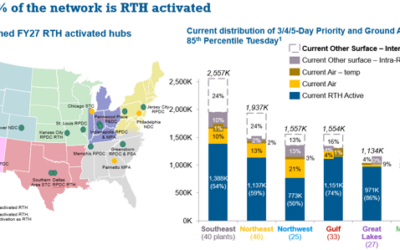
- RTH (Regional Transfer Hubs)
- Role: Used by USPS to cross-dock pallets from one region to another.
- Status: 19 Active / ~30 Target
- Deployment: Standalone facilities (e.g., Dallas) or collocated inside RPDCs (e.g., Boise, Richmond, Portland).
- TC / THC (Surface & Terminal Centers)
- Role: Transfer and processing centers for First-Class/Air mail and packages.
- Status: Transitioning from private contractors to direct USPS operations; last 3 of 13 STCs insourced by year-end.
RPDC & RTH Activations by year:

USPS End-to-End Visibility Pillars
There are three customer groups impacted by visibility, the senders, receivers, and postal operations. USPS is making improved visibility a key agenda initiative for 2026 and 2027, through BLE enabled container placards, container visioning and PTR scans.
BLE-enabled PMOD tracking uses powered Bluetooth Low Energy (BLE) beacons to track PMOD container location and dwell time. This helps to identify opportunities to streamline PMOD material flow. They have been piloting on packages at the Charlotte PRDC and LPC using battery-free internet of things (IoT) trackers powered by ambient radio waves with integrated systems capturing scans at dock doors and work staging zones.
The hardware has been completely installed in Charlotte with the remaining 10 sites targeted for completion by mid-October.
The platform leverages existing cameras to identify and track containers and alert operations to delayed containers for targeted resolution with a focus on resolving long-delayed containers that have dwelled for over 24 hours.

Section 3: Fraud Mitigation & Operations
USPS Office of Inspector General (OIG) Activity

The OIG has published two recent audits on fraud and the Postal Services’ efforts to mitigate counterfeit postage.
Report Nr. 25-121-R26
Counterfeit Stamps: A Growing Risk to Traditional Revenue
Stamps generate over $4.4 billion annually for the Postal Service, primarily through Forever stamps. However, sophisticated counterfeit operations—frequently operate online and overseas—sell fake bulk stamps at discounts ranging from 20 to 50 percent off face value.
Financial Impact
- Revenue Loss: The OIG estimated $349 million in revenue losses linked to counterfeit stamp vulnerabilities in FY 2026.
- Revenue at Risk: An additional $1.7 billion in revenue is considered at risk for FY 2026 due to processing gaps for stamped mail outside standard cancelling operations.
The OIG found that mail processing equipment (such as the Advanced Facer Canceller System 200) was frequently run in “low-revenue protection mode” to avoid processing delays. In this setting, the machines failed to catch counterfeit stamps that improperly passed basic luminescence tests.
Report Nr. 25-072-R26
While fake stamps represent a massive loss, counterfeit shipping labels present an even larger financial bleed. In FY 2025 Louis DeJoy told Congress that “counterfeit postage had become a $1 billion problem”—a figure the OIG’s data showed to be a gross underestimate.
Financial Impact
- Actual Unrecoverable Revenue Loss: The OIG estimated that counterfeit package labels caused $3.1 billion in unrecoverable revenue losses between March 2024 and February 2026.
- Future Revenue at Risk: The agency projects an additional $520 million in losses through February 2028 if vulnerabilities remain unaddressed, bringing the total 4-year impact to $3.62 billion.
- Operational Waste: Misrouted or mistakenly intercepted paid packages cost the USPS an estimated $7.2 million in unnecessary re-processing and transportation costs
The OIG found that bad actors’ fraudulent schemes shifted rapidly to exploit systemic gaps—such as duplicated labels, forged tracking numbers, and Enterprise Payment Account (EPA) fraud far faster than USPS could update its intercept processes and prevent billions in revenue loss.
USPS executive leadership agreed with most the OIG’s recommendations and committed to implementing an enterprise-wide Counterfeit Postage National Strategy alongside new technological and operational controls scheduled through 2027.
PostalOne! Challenges and Opportunities
Today mailers submit mail.dat, mail.xml or postal wizard statements through the business customer gateway, in 2025 they were used for 91.3 billion mailpieces. Mail.dat accounted for 88.7% of all PostalOne! Volume. Due to the size and complexity of large mailings many mailers experienced delays and issues with PostalOne! Submissions this summer. USPS is committed to continuously improving PostalOne! customer experience, and will implement stronger processes to ensure issues impacting customers are handled quickly and communicated effectively.
In addition to newer communication models, USPS is working on two specific paths for process time improvements.

Section 4: Retail & Consumer Initiatives
2026 Holiday Mailing and Shipping Dates
The U.S. Postal Service announced the recommended mailing and shipping dates for the 2026 holiday season.
To have your cards and packages received by Christmas Day December 25th, USPS suggests the following dates as the last date for mailing and shipping.
2026 Holiday Shipping Dates for Contiguous U.S. (Lower 48 States)
- USPS Ground Advantage service: Dec. 17
- First-Class Mail: Dec. 17
- Priority Mail: Dec. 18
- Priority Mail Express: Dec. 19
2026 Holiday Shipping Dates for Alaska, Hawaii, Puerto Rico and U.S. Territories
- USPS Ground Advantage service: Dec. 16
- First-Class Mail: Dec. 17
- Priority Mail: Dec. 18
- Priority Mail Express: Dec. 19
For a complete list of suggested dates to send packages to military or international addresses, the Postal Service recommends visiting the USPS holiday shipping page beginning mid-Oct.
Operation Santa
The annual Operation Santa program kicks off the 2026 holiday season connecting hopeful children and families with generous individuals and organizations who help fulfill their holiday wish lists. The program operates entirely through voluntary “letter adoption,” ensuring privacy while bringing holiday cheer across the country.

How Writing to Santa Works
To participate as a letter writer, children and families send their holiday wish lists directly to Santa’s designated post office address:
- Official Address: Letters must be sent to 123 Elf Road, North Pole, 88888 with proper First-Class™ postage attached.
- Letter Requirements: Letters must include a full return address (including full name and apartment/suite numbers) so fulfilled packages reach the recipient.
- Personal last names and physical addresses are redacted online before letters are published to preserve privacy.
- Key Deadline: Letters must be postmarked by December 5 to be eligible for adoption.
How Adopting a Letter Works
Volunteers can step in to read letters and adopt wish lists to ship gifts directly to writers:
- Register & Verify: Adopters sign up at USPSOperationSanta.com and complete a quick identity verification check to keep participants safe. Registration opens in early November.
- Browse Wish Lists: Starting November 16, verified adopters can search through submitted letters online by location, gift preferences, or household size. Adopters can choose individual letters or adopt an entire family together.
- Shop & Ship: Adopters fulfill gift requests either by shopping through the program’s online catalog (Santa’s Gift Shoppe) or purchasing items on their own to ship via USPS. Adopters pay the standard postage fees, and packages are delivered anonymously under Santa’s name.
- Adoption Deadline: Letter adoption closes on December 12, which is also the recommended cutoff date to send gifts for expected delivery before Christmas.
The Operation Santa web site includes resources and tips, along with a FAQ page to answer all questions.

USPS Local XChange
The Local Xchange program which launched earlier in the year has now grown with 570 lockers available nationwide with an additional 64 planned by the end of the month.

The program has online marketplaces transforming how people buy and sell vintage, niche, and local finds. USPS Smart Lockers help customers make local exchanges safely and conveniently with secure, self-service access. For a fixed $5.51 fee, sellers can add a peace of mind for themselves and the buyer. For peer-to-peer retail transactions a seller can use a ConnectLocal shipping label and drop off a package scanning it to a smart locker so that a buyer can then safely use a QR code to come in and pick up their purchase without any face to face interaction.

Self-Service Only Post Offices (SOPOs)
A Self-Service Only Post Office (SOPO) is an unstaffed USPS retail location that provides a convenient 24/7 option for customers to complete 90% of USPS retail transactions through self-service technology. There are two locations in progress, the designs are complete and the construction is pending in Dallas, TX and Swannanoa, NC. Future sites are evaluated for community fit and the need to maintain retail access. Considerations will be; businesses in proximity, population density, household income, 24/7 safety, facilities losing leases, discontinuation due to disasters and site consolidations due to S&DCs.

Section 5: Industry Events & Key Contact
National Postal Forum 2027 (NPF)

The 2027 NPF will be hosted at the Marriott World Center in Orlando Florida starting on May 16th running through May 19th.
This year’s theme is “Rising Together” Illuminating the future of Mailing and Shipping.
The NPF has officially opened its call for presentations; it is looking for engaging 50-minute workshop presentations that address the opportunities and challenges facing the mailing and shipping industry today. It must follow one of the tracks and be submitted no later than October 16th, 2026.
There are five educational tracks in 2027.
- Direct Mail Performance & Omnichannel Innovation: Direct mail strategy, USPS promotions & incentives, personalization, creative innovation, omnichannel integration, AI, targeting, and measurement.
- Leadership, Talent & Organizational Agility: Workforce development, communication, coaching, mentorship, organizational culture, change readiness, and AI fluency.
- Mail Operations, Policy & Postal Performance: Postal policy and regulations, pricing, classification, compliance, address quality, operational automation, and cost optimization.
- Shipping, Logistics & Network Intelligence: Shipping strategy, fulfillment, USPS shipping solutions, logistics intelligence, predictive analytics, last-mile execution, and network resilience.
- AI, Automation & Data Intelligence: Generative and agentic AI, automation technologies, predictive intelligence, and digital transformation.
Here is the link to submit your proposed presentation. NPF Presentations
USPS and Industry Events
GrayHair will be presenting or in attendance at all events listed in red. If you will be attending, please let your GrayHair representative know so we can plan to meet up!
National PCC Week, September 28th – October 2nd, Various
SunStates PCC, October 2nd, 2026, Lake Buena Vista, FL
National Postal Policy Council October 8th, Arlington, VA
Fall MTAC, October 20th-21st, Washington, D.C.
2027
Winter MTAC January 26th – 27th, Washington, D.C.
NAPM Annual Conference, February 15th-18th, Orlando, FL
DTAC Spring Meeting, March 2nd-3rd, Savannah, GA
Spring MTAC April 20th – 21st, Washington, D.C.
National Postal Forum, May 16th-18th, Orlando, FL
PostCom Summer Meeting, June 8th-9th, Washington, D.C.
DTAC Summer Meeting, June 9th – 10th, Washington, D.C.
Summer MTAC July 20th – 21st, Washington, D.C.
DTAC Fall Meeting, September 8th – 9th, Chanhassen, MN
PostCom Fall Meeting, September 21st – 22nd, Alexandria, VA
For more information on these topics or other postal issues contact GrayHair Software at engage@grayhairsoftware.com